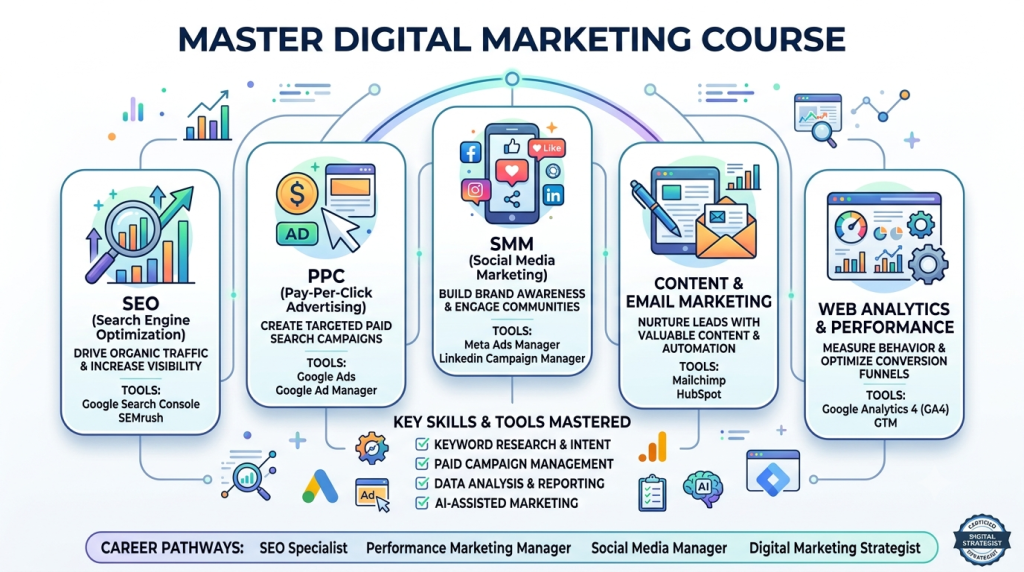
Digital marketing course
In today’s technology-driven marketplace, a strong online presence is no longer optional for businesses—it is vital for long-term growth and survival. As consumer behavior continues to shift toward mobile devices, search engines, and social media platforms, the demand for skilled online marketers has reached an all-time high. Whether you are a recent graduate exploring career paths, a working professional seeking a skill upgrade, or an entrepreneur aiming to scale your venture, enrolling in a comprehensive digital marketing course is one of the most effective investments you can make for your future.
Unlike traditional marketing methods such as print, billboards, and television ads, digital channels offer real-time performance tracking, precise audience segmentation, and measurable return on investment. A structured digital marketing course bridges the gap between basic internet familiarity and professional-level execution by combining theoretical strategy with practical tool training. Throughout a complete curriculum, learners dive into Search Engine Optimization to drive organic traffic, Pay-Per-Click advertising to capture high-intent leads, and Social Media Marketing to foster community engagement and build brand equity. Furthermore, robust programs cover content creation, email automation, and web analytics using tools like Google Analytics 4, ensuring you can track user conversion funnels and make data-driven decisions.
Graduating from a recognized digital marketing course opens doors to a wide variety of high-demand roles across every industry sector. Program graduates can specialize as SEO strategists, performance marketing managers, social media directors, or overarching digital strategists, working in-house, for marketing agencies, or as independent consultants. By mastering search platforms, paid ad channels, and analytical frameworks, you gain the practical capabilities required to generate leads, lower acquisition costs, and thrive in an increasingly digital economy.
The Ultimate Guide to Enrolling in a Digital Marketing Course
Enrolling in a structured digital marketing course provides a vital competitive edge in an increasingly automated and data-driven business landscape. Modern digital marketing goes far beyond posting on social media; it involves mastering complex algorithms, understanding consumer psychology, and deploying automated funnel workflows that nurture cold leads into loyal customers. Through dedicated training, students learn how to execute comprehensive market research, build detailed customer personas, and optimize user experience to minimize bounce rates and maximize conversion ratios. They also gain crucial hands-on experience with emerging technologies, including artificial intelligence tools that streamline content generation, hyper-targeted ad placement, and predictive customer analytics, ensuring their marketing strategies remain efficient and ahead of industry trends.
Furthermore, a quality digital marketing course instills a deep strategic mindset centered on cross-channel integration and continuous optimization. Instead of treating channels in isolation, trained marketers know how to synchronize Search Engine Optimization, social proof, email marketing, and pay-per-click ads into a cohesive ecosystem that guides potential buyers through every stage of the sales funnel. They become proficient in dynamic budget allocation, learning how to reallocate funds toward high-performing campaigns while pausing underperforming channels based on real-time data metrics. This ability to interpret complex data dashboards, execute A/B split testing, and continuously refine campaign messaging makes digital marketing graduates indispensable assets to companies seeking sustainable, scalable online growth.
Digital Marketing Course: 7 Best Strategies to Master Growth in 2026
In today’s technology-driven marketplace, a strong online presence is no longer optional for businesses—it is vital for long-term growth and survival, making enrollment in a professional digital marketing course one of the single most impactful career decisions you can make. As consumer behavior continues to shift overwhelmingly toward mobile devices, search engines, and social media platforms, the global demand for certified online marketers has reached an all-time high across every industry. Whether you are a recent university graduate exploring lucrative career pathways, a working professional seeking a critical skill upgrade, or an ambitious entrepreneur aiming to scale your own business venture, taking a structured digital marketing course provides the exact technical blueprint needed to succeed. Unlike traditional advertising methods such as print, radio, billboards, and television, modern online marketing channels offer real-time performance tracking, precise demographic targeting, dynamic budget management, and highly measurable returns on investment. A top-tier digital marketing course bridges the gap between basic internet familiarity and high-level strategy execution by combining deep theoretical understanding with hands-on tool training. Throughout a comprehensive curriculum, students immerse themselves in Search Engine Optimization to drive organic website traffic, Pay-Per-Click advertising to capture high-intent leads, and Social Media Marketing to foster active community engagement and build long-term brand equity. Furthermore, specialized modules in a digital marketing course cover long-form content creation, email workflow automation, conversion rate optimization, and web analytics using industry-standard tools like Google Analytics 4, ensuring learners can track complex multi-touch attribution models and make data-driven marketing decisions. Enrolling in a digital marketing course provides a crucial competitive advantage in an increasingly automated business environment, teaching marketers how to move past simple social posts and master algorithmic audience building, consumer psychology, and integrated sales funnels that seamlessly nurture cold prospects into loyal paying customers. Through dedicated coursework in a digital marketing course, students also learn how to execute thorough competitive research, map detailed buyer personas, and design user-friendly landing pages that minimize bounce rates while maximizing overall conversion efficiency. Participants gain practical experience with cutting-edge artificial intelligence systems that streamline campaign management, automate personalized messaging, and enable predictive analytics so their strategies stay adaptable to rapid tech shifts. Furthermore, a high-quality digital marketing course instills a cross-channel strategic mindset, showing how to synchronize organic search efforts, paid advertisements, influence campaigns, and email nurturing into a unified growth engine. Instead of operating channels in isolation, students who complete a digital marketing course learn how to balance budgets dynamically, shifting capital to top-performing campaigns based on real-time cost-per-acquisition metrics and return on ad spend. Upon graduating from a recognized digital marketing course, individuals unlock direct access to a vast array of high-demand professional roles, including SEO specialist, performance marketer, social media director, and digital growth strategist, with options to work in-house, join an agency, or build a flexible freelance consulting practice. Ultimately, taking a digital marketing course equips you with the exact technical skills, strategic frameworks, and analytical mindset needed to generate predictable leads, lower customer acquisition costs, and drive scalable revenue in today’s fast-paced digital economy.
Final Thoughts
Enrolling in a digital marketing course provides the structured environment, technical skills, and practical foundation needed to excel in modern business. By mastering search engines, social media platforms, paid advertising, and analytics, you position yourself as a crucial asset in an increasingly digital world.